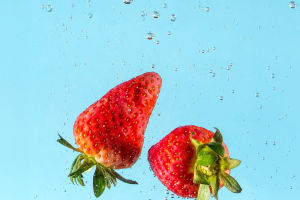
After a rainstorm, you might notice tiny water droplets clinging to a window, a car windshield, or a freshly waxed surface. Some form nearly perfect beads, while others spread out or slide downward.
These differences are not random. They arise from interactions among water molecules, the surface beneath them, and gravity. Understanding that balance explains why droplets often appear round, but do not always keep the same shape.
Water Pulls Itself Tight
Water molecules attract one another through interactions that include hydrogen bonding. These cohesive forces give water a relatively high surface tension.
Molecules at a liquid's surface experience a different balance of neighboring molecular interactions from those inside the liquid. As a result, creating additional surface area requires energy, and surface tension tends to minimize that area.
For a given volume, a sphere has the smallest possible surface area. That is why a small water droplet surrounded by air tends toward a spherical shape when other forces are relatively weak.
Surface tension acts along the liquid's surface rather than simply pushing inward from every direction. Its overall effect, together with the pressure difference across a curved surface, helps the droplet maintain its shape.
A droplet resting on a solid surface is different from one suspended in air. Contact with the surface changes the balance of forces, often producing a rounded cap rather than a complete sphere.
The Glass Gets a Vote Too
The shape of a droplet on a solid surface depends on how water interacts with that material.
Scientists describe this behavior in terms of wettability, which is commonly measured by the contact angle at which the liquid, solid, and surrounding air meet.
On clean, untreated glass, water generally spreads relatively easily because the surface is hydrophilic, meaning it has an affinity for water.
This produces a smaller contact angle and a flatter droplet. The exact behavior depends on the glass's condition, including contamination or surface treatments.
A waxed car surface is typically more water-repellent, or hydrophobic. Water tends to form taller, more rounded beads with larger contact angles.
On some specially textured water-repellent surfaces, droplets can become almost spherical and roll away readily.
The difference is not that water has changed its surface tension dramatically. Instead, the interfacial energy balance has changed because the underlying surface interacts differently with the liquid.
Why Droplets Are Not Perfect Spheres
Real droplets are influenced by gravity, the surfaces they touch, and sometimes air movement.
For very small droplets, surface tension generally dominates over gravity, helping them retain rounded shapes.
As droplets become larger, their weight becomes increasingly important. A drop resting on a horizontal surface may flatten, while one clinging to a vertical window may stretch downward.
The characteristic length at which gravity and surface tension become comparable is called the capillary length. For water under ordinary conditions, it is approximately 2.7 millimeters.
This does not mean every droplet larger than 2.7 millimeters loses its round shape. Actual behavior depends on its geometry, volume, contact angle, and the degree to which its contact line remains attached to the surface.
You can observe this on a cold drinking glass. Tiny condensation droplets may appear nearly circular, while larger ones merge, become elongated, or leave streaks as they move.
The familiar teardrop shape is therefore not the natural shape of every falling water droplet. Small drops falling through air are usually nearly spherical, while larger drops can become flattened or distorted by aerodynamic forces.
Round Drops and Foggy Windows
Surface tension and wettability also help explain why windows and mirrors sometimes become foggy.
When warm, humid air encounters a sufficiently cool surface, water vapor can condense into many tiny liquid droplets.
These droplets scatter light, reducing the clarity of the glass. The foggy appearance comes from the combined optical effects of numerous small droplets rather than from a single large bead.
Anti-fog treatments often work by changing how water wets the surface.
Some coatings make glass more hydrophilic, encouraging condensed water to spread into a relatively uniform, thin film instead of forming many separate droplets.
A sufficiently even film can reduce the light scattering that makes a mirror or lens appear cloudy.
However, anti-fog performance depends on coating quality, cleanliness, and environmental conditions. A water film is not automatically invisible, and uneven films can still distort vision.
The same principles are used in certain eyewear, mirrors, and transparent protective surfaces.
Nature Uses the Same Principles
Nature provides striking examples of how surface structure influences water droplets.
Lotus leaves are famous for their ability to repel water. Their surfaces contain microscopic and nanoscale structures, together with water-repellent surface chemistry, that can produce very high contact angles.
Water droplets often roll off these leaves easily, collecting loose dirt particles along the way. This behavior is known as the lotus effect and has inspired research into self-cleaning coatings and materials.
Spiderwebs provide another example, although their behavior is more complex.
Water can collect on silk threads through condensation or contact with moisture. The arrangement of threads, the properties of the silk, and local environmental conditions influence where droplets form and remain attached.
Some spider silks also have specialized structures that affect how water moves along their surfaces.
Both examples involve surface tension, but the resulting droplet patterns depend on the properties of each surface.
The lesson is that water's tendency to form rounded droplets is only part of the story. The surrounding materials help determine what shape those droplets actually take.
Water droplets often look round because surface tension favors shapes with relatively little surface area. But their final appearance depends on more than water alone. Glass, wax, leaves, and other surfaces influence how strongly droplets spread or bead up, while gravity becomes increasingly important as droplets grow. From condensation on a cold glass to water rolling off a lotus leaf, the same basic physical principles produce a remarkable variety of shapes. The next time you notice a tiny bead of water, look at the surface beneath it. That surface is helping determine the droplet's shape.