Hi Lykkers! High above the valleys of Central Asia, where rocky slopes replace forests, and winter can turn the landscape into a maze of snow and ice, an exceptionally elusive predator moves almost invisibly. The snow leopard (Panthera uncia) is built for this demanding environment, combining powerful hind legs, enormous paws, dense fur, and an unusually long tail.
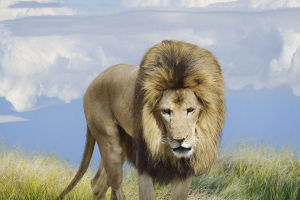
Unlike lions that dominate open grasslands or tigers that often rely on forests and wetlands, snow leopards have evolved around steep, broken terrain. Their survival depends on staying hidden, moving efficiently across unstable slopes, and finding enough prey in landscapes where food can be widely scattered.
A Cat Designed for Steep Terrain
The snow leopard's body reveals how strongly its lifestyle is tied to mountains. Its hind legs are longer and more powerful than its forelegs, giving the cat remarkable jumping ability and helping it navigate sharp changes in elevation. Large paws are another important adaptation. Their broad shape spreads the animal's weight across snow, reducing the tendency to sink. Thick fur on the underside also provides insulation and additional grip when the cat crosses cold, rocky surfaces.
The tail is perhaps the most striking feature. It can be nearly as long as the body and is thickly covered with fur. While moving across cliffs and narrow ledges, the tail works as a counterbalance. When temperatures drop, the animal can also wrap the tail around its body, helping conserve warmth.
Its Coat Is More Than Camouflage
Snow leopard fur is generally grayish or smoky in appearance, marked with dark spots and large rosettes. That pattern breaks up the outline of the animal against rocks, shadows, snow patches, and mountain vegetation. The camouflage becomes particularly valuable because snow leopards are ambush hunters. Rather than charging across open ground for long distances, they often use rocks and uneven terrain to approach prey without being detected.
Why Snow Leopards Are Called Mountain Ghosts
Finding a snow leopard in the wild is notoriously difficult. Their reputation as "ghosts of the mountains" comes from more than their camouflage. The cats are generally solitary and occupy enormous territories. Some individuals can use home ranges extending hundreds of square kilometers, meaning researchers may spend months collecting information from camera traps, tracks, scent markings, and other signs without seeing the animal directly.
A Predator That Chooses Its Prey Carefully
Snow leopards hunt a range of mountain animals. Important prey includes wild sheep and goats such as blue sheep and ibex, while smaller targets can include marmots, pikas, and other mammals. A hunt may begin from a concealed position. The cat uses rocks and changes in elevation to approach its target before launching a sudden attack. Powerful hind limbs allow it to leap between uneven surfaces while pursuing prey across steep ground.
Why They Cannot Roar Like Lions
Despite belonging to the same broader cat family as lions and tigers, snow leopards cannot produce a true roar. Instead, they communicate using sounds such as growls, yowls, mews, and a soft nasal vocalization known as prusten or chuffing. Their communication also relies heavily on scent marking and visual signs left around frequently used routes.
Life at Extreme Elevations
Snow leopard habitat stretches across 12 countries in Central and South Asia, covering an enormous area of approximately 2 million square kilometers. Much of this range consists of high-altitude mountain ecosystems, although elevation varies considerably between regions. In some regions, they can occur at elevations approaching 18,000 feet. Elsewhere, individuals may inhabit considerably lower landscapes, particularly where suitable prey, rocky cover, and relatively undisturbed habitat are available.
The Biggest Threat May Come From Outside the Mountains
The snow leopard's greatest challenge is no longer simply surviving cold and steep terrain. Human activity is changing the ecological conditions on which the species depends. Declining wild prey can push snow leopards toward livestock. When a predator kills sheep, goats, or other domestic animals, herders may suffer serious economic losses, sometimes leading to retaliatory killing of the cats.
Protecting the Ghost of the Mountains
Saving snow leopards requires more than protecting the cats themselves. Their future depends on maintaining healthy prey populations, preserving connected mountain habitat, and reducing conflict with communities that share the same landscapes. Projects such as predator-proof livestock corrals, improved livestock management, community conservation programs, and long-term camera-trap monitoring can help address those challenges.
The snow leopard's story is one of quiet resilience – a creature perfectly sculpted by evolution to thrive where few others can. Yet its greatest test comes not from nature, but from our own expanding footprint. Protecting this mountain ghost means preserving entire ecosystems, supporting local communities, and recognizing that wild places have value beyond what we extract from them.
Every protected corridor and every reduced conflict brings us closer to ensuring that these elusive cats continue to move silently across their rocky kingdoms for generations to come.