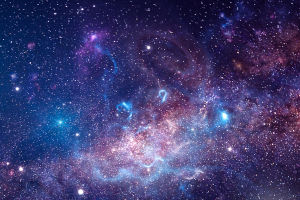
Hello, Lykkers! Have you ever looked up at a starry sky and felt like you were staring into an infinite ocean of light?
Well, prepare to have your mind gently blown: all those glittering points, every galaxy, every nebula, every particle of cosmic dust you can spot through a telescope?That whole dazzling show makes up less than five percent of the entire universe.
Yes, really. The other 95 percent is a cosmic ghost story starring two mysterious characters: dark matter and dark energy.
What Are We Actually Seeing?
When you gaze at the night sky, you're witnessing the universe's "visible" matter—stars, gas, dust, planets, and us. This stuff is made of atoms, the same kind of particles that form your coffee mug and your toenails. But here's the kicker: all that atomic matter, from the tiniest particle to the biggest galaxy, accounts for only about 4.9 percent of the total mass-energy of the cosmos. That's like walking into a massive library and realizing every book you can see is just a handful of pamphlets in a room filled with invisible shelves.
The Dark Side: Dark Matter
Roughly 26.8 percent of the universe is dark matter. It doesn't emit, absorb, or reflect light, so it's completely invisible to our telescopes. We know it exists because of its gravitational effects—it holds galaxies together, preventing them from flying apart like a toddler's temper tantrum. Without dark matter, the Milky Way would spin itself into a cosmic salad. Yet we have no idea what it's made of. It doesn't interact with normal matter except through gravity, which makes it the ultimate wallflower.
Even Darker: Dark Energy
Then there's dark energy, the big boss, making up about 68.3 percent of the universe. This is even weirder. Dark energy is a mysterious force that's causing the universe to expand at an accelerating rate. Think of it as the universe hitting the gas pedal instead of coasting after the Big Boom. We have no clue what it is, either—just that it's there, pushing everything apart like an overeager friend clearing the dance floor.
How Do We Know All This?
Scientists figured this out by studying the cosmic microwave background—the afterglow of the Big Boom—and mapping galaxy clusters. They measured how light bends around invisible mass (gravitational lensing) and watched how galaxies move. Everything pointed to the same conclusion: we are the minority. The visible universe is just the tip of the iceberg, and the iceberg is mostly made of invisible stuff.
Why Should You Care?
Well, for starters, it's humbling. Every time you look up at a star, you're seeing only a tiny fraction of what's out there. It's like opening your fridge, seeing one apple, and realizing the rest of the kitchen is full of invisible apples. This knowledge also drives modern physics—researchers are hunting dark matter particles deep underground and building giant telescopes to map dark energy's effects. We're basically cosmic detectives trying to find the universe's lost 95 percent.
So next time you're under a starry sky, remember: you're looking at the universe's small talk. The real conversation is happening in the dark, and we're just starting to learn the language. Keep your eyes on the skies and your curiosity even wider.