Hi, Readers! When people think about monkeys, they often imagine energetic animals leaping through trees or interacting with people in unexpected ways.
However, monkeys are far more complex than their popular image suggests. These intelligent mammals display a wide range of behaviors, social structures, and survival strategies.
They inhabit diverse environments, from tropical rainforests in South America to rugged mountain regions in North Africa.
Monkeys Share a Deep Family Connection With Humans
Monkeys belong to the order Primates, the same biological group that includes apes and humans. This relationship explains why monkeys display many behaviors that seem surprisingly familiar, such as using tools, caring for family members, and solving problems through observation.
Although monkeys and humans did not evolve directly from one another, they share ancient common ancestors that lived millions of years ago. Fossil evidence and genetic studies reveal that primates developed traits like forward-facing eyes, flexible hands, and relatively large brains because these features improved survival in complex environments.
Researchers have even observed several monkey species learning from one another. Young monkeys often copy adults when searching for food or avoiding danger, creating traditions that can spread through entire groups. This ability to pass knowledge socially was once considered unique to humans.
Every Monkey Has a Tail, Even When You Can Barely See It
One of the easiest ways to distinguish a monkey from an ape is the presence of a tail. Gorillas, chimpanzees, orangutans, and gibbons have none, but every monkey species possesses one, although its size and function can vary dramatically.
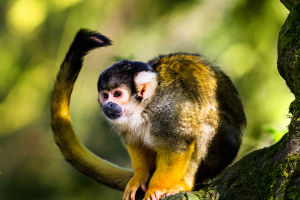
The Barbary macaque, which inhabits parts of Morocco and a small population in Gibraltar, appears almost tailless because its tail is only a short stump. In contrast, species such as woolly monkeys and spider monkeys carry long tails that are essential for life high in the forest canopy.
A monkey's tail is not simply an extra limb hanging behind it. In many species, it serves as a balancing tool when leaping across branches or moving rapidly through uneven terrain. This adaptation allows monkeys to travel efficiently while keeping their hands free for climbing or carrying food.
The Monkey Family Is Astonishingly Diverse
Scientists currently recognize more than 250 living species of monkeys, making them one of the most varied groups of mammals on Earth. Their sizes alone demonstrate this incredible diversity.
The pygmy marmoset, native to the Amazon rainforest, is the smallest monkey in the world. Adults weigh little more than a stick of butter and can comfortably cling to a person's finger. At the opposite end of the scale are large baboons, powerful ground-dwelling monkeys that can weigh over 30 kilograms and defend themselves with impressive canine teeth.
Their habitats are equally varied. Some species spend almost their entire lives in tropical forests, while others thrive in rocky mountains, mangrove swamps, and even busy cities. Rhesus macaques, for example, have adapted so successfully to human settlements that they can be found navigating streets and temples across parts of Asia. This extraordinary range of environments highlights one of the greatest strengths of monkeys: adaptability.
The World's Monkeys Are Divided Into Two Ancient Lineages
Biologists classify monkeys into two major groups known as New World monkeys and Old World monkeys. This distinction is based on evolutionary history rather than modern geography alone.
New World monkeys live in Central and South America. They are scientifically known as platyrrhines, a term referring to their broad noses with outward-facing nostrils. Many species are highly specialized for life in dense rainforests, where agile climbing is essential.
Old World monkeys inhabit Africa and Asia. These catarrhine monkeys typically have narrower noses with downward-facing nostrils and often spend more time on the ground than their American relatives.
The separation between these groups stretches back tens of millions of years. Scientists believe the ancestors of New World monkeys reached South America from Africa through a series of rare natural events, possibly involving floating vegetation mats carried across the ancient Atlantic Ocean when the continents were closer together. Over countless generations, isolation shaped two distinct branches of monkey evolution.
Some Monkeys Can Use Their Tails Like an Extra Hand
Perhaps the most astonishing adaptation found in certain monkey species is the prehensile tail. Unlike ordinary tails used mainly for balance, a prehensile tail can grasp and hold objects.
Spider monkeys are among the best examples. The underside of the tail tip lacks fur and contains highly sensitive skin, creating a gripping surface that functions almost like a palm. These monkeys can suspend their entire body weight from a single branch while reaching for fruit with both hands.
This adaptation gives them a major advantage in the crowded rainforest canopy. Instead of climbing down and back up between trees, they can move gracefully through the upper branches while remaining secure. Interestingly, fully prehensile tails are found only in several New World monkey species. Old World monkeys never evolved this feature, making it one of the clearest differences between the two lineages.
The next time you see a monkey in a documentary, a wildlife sanctuary, or even perched on a temple wall, remember that you are looking at an animal shaped by millions of years of evolution. Their intelligence, specialized anatomy, and incredible adaptability have allowed them to survive in environments ranging from Amazonian jungles to rocky mountain slopes.