Overhead clears in badminton look easy from the sidelines — but in a game, they often land too short or drift off target, giving your opponent an easy chance to attack.
Most mistakes come down to two main factors: power generation and mechanics. The good news? Both can be improved with the right drills and proper technique.
Start with grip, footwork, and swing mechanics, and you’ll quickly see more consistent clears that push your opponent to the backcourt.
Load the Chain, Then Release It
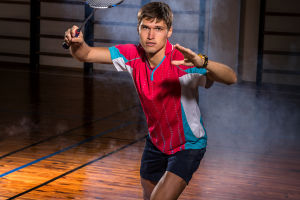
As you prepare to hit, point your non-racket arm up toward the shuttle. Pull your racket arm back with the elbow bent at around 90 degrees. From there, the power doesn't come from your arm alone — it travels up from your legs, through your hips, rotates through your torso and shoulders, and fires through your arm in one throwing motion. Lead with your elbow as you swing forward, tighten your grip at the point of contact, and aim to make contact when the shuttle is high above you and just slightly in front. If the shuttle gets behind your body, you lose both power and control immediately.
The Tennis Ball Drill: Boring But Effective
Grab a tennis ball and practice the throwing motion without letting go. Add a small scissor kick before each throw to simulate the jump you'd use in a real overhead. This may sound too basic to matter — but it isn't. The throwing motion is exactly what the overhead clear swing should feel like, and training it without a racket helps your body understand the sequence before adding the complexity of actually hitting a shuttle. After two or three minutes of that, pick up the racket and shadow the same motion.
Two-Player Drills That Build Real Skill
Once your mechanics feel decent, get a partner. Stand on opposite sides of the court, both in the backcourt on the same side. Start with a high serve, then trade straight overhead clears back and forth for three to five minutes. After that, move crosscourt — now you're forcing yourself to change the angle and direction of each clear, which is much closer to what a real rally demands.
The next step up is the lift-clear-drop drill. Your partner lifts the shuttle to your backcourt forehand corner. You clear it back. They reply with a drop shot to your frontcourt. You lift. They clear. You drop. Doing this for five to ten minutes trains footwork, timing, and shot selection simultaneously — not just the clear in isolation.
For precision work, multishuttle feeds are the sharpest tool. Your partner feeds shuttles one after another to your backcourt while you clear each one as accurately as possible — right corner, center, then left corner. This forces you to control direction under fatigue, which is exactly when accuracy tends to collapse.
Mastering your overhead clear takes practice, patience, and proper mechanics. By combining the drills above with mindful footwork and grip adjustments, you’ll see more consistent clears, gain control of rallies, and put your opponent on the defensive. Remember: precision comes with repetition, so make these drills a regular part of your training.